
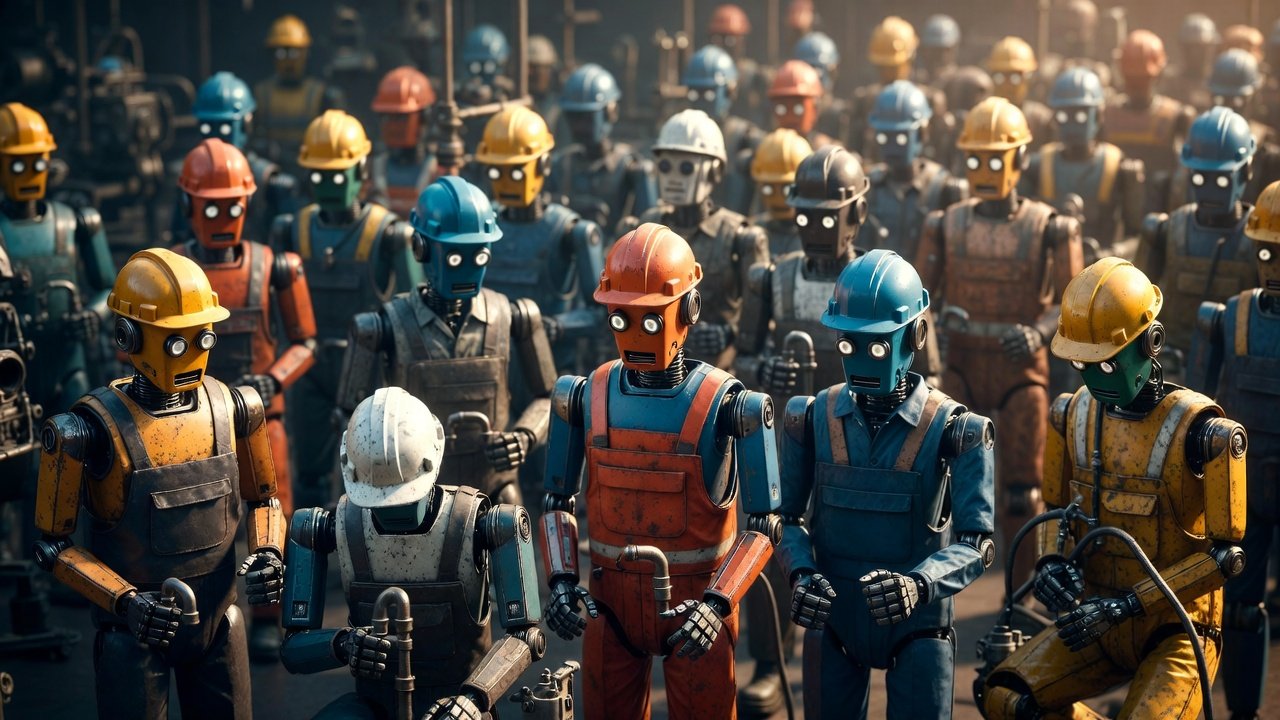
Humanity is not prepared for what is coming…
AI is not progressing in a straight, predictable line. It is accelerating at a pace that most people cannot conceptualise, and we have now crossed a threshold that should genuinely give us pause; AI systems are beginning to write and optimise the code for the next generation of AI. The machine is improving the machine, which means progress is no longer simply exponential, it is compounding intelligence building on itself.
Within one, two, perhaps three years, a significant portion of white-collar work will no longer require human input in the way it does today. Not because humans lack talent or value, but because systems will execute tasks faster, more accurately, more consistently, and at near-zero marginal cost. Law, finance, administration, research, logistics, analysis, design, even elements of medicine and education are already being reshaped in real time.
The comforting illusion is that this is some distant future, but it is not. The shift is happening now, what is lagging behind is our psychological readiness to absorb what it means.
There is no serious scenario in which AI does not end up running the majority of systems that underpin modern civilisation. So the question many are asking is what happens to me when my role becomes redundant? If I am replaced at work, how do I sustain myself financially, and what becomes of my sense of purpose?
I have never been comfortable with the idea of universal basic income. The notion of mass dependence on the state feels like thr erosion of sovereignty, and that concerns me. Yet we cannot ignore the structural reality that the economic architecture we have lived under for decades is about to end. And is that a bad thing? I don’t think so…
If we are honest, the current system has functioned less like a free market of empowered individuals and more like a sophisticated free-range tax farm. The framework itself is designed to extract: income tax, corporate tax, property tax, capital gains tax, inheritance tax, inflation operating as hidden taxation, and regulatory compliance layered into every transaction. From cradle to grave, productivity is constantly siphoned into the system.
We call this normal because we were born into it. Work hard, earn, surrender a substantial portion of what you produce, and trust that it will be managed wisely. Much of the fraud and waste now being exposed across governments and institutions did not arise by accident. It thrived precisely because complexity protects it. The more opaque the structure, the easier it is to extract from it.
AI has the potential to dismantle that complexity; highly automated, real-time, transparent systems leave far less room for bureaucratic opacity. When transactions, budgets and processes can be tracked, audited and optimised instantly, the layers that exist purely to mediate, obscure and extract become unnecessary.
Perhaps what we are witnessing is not only a labour shift, but the beginning of the end of a civilisation model built primarily around extraction.
That does not automatically mean liberation, it depends entirely on who controls the systems. AI can centralise power, or it can expose it. It can entrench digital feudalism, or it can force transparency that makes large-scale corruption structurally unsustainable. Technology amplifies intent, so we must keep a watchful eye on the direction it takes, because it will quickly reflect the consciousness of those who guide it.
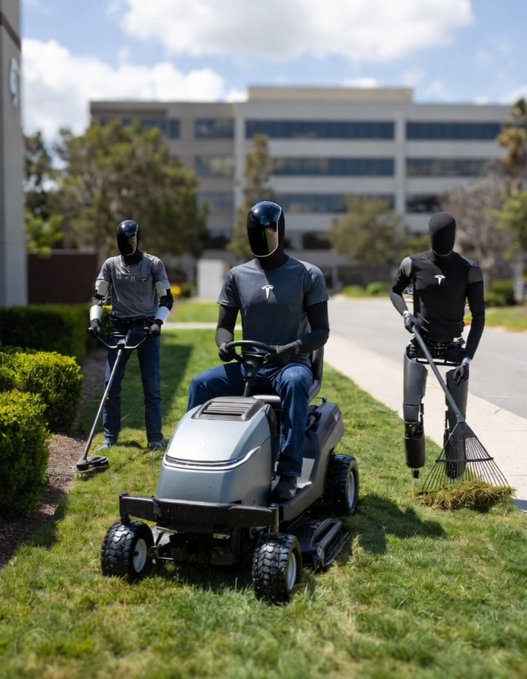
If machines reduce waste, eliminate vast bureaucratic redundancies and optimise resource allocation, the need to keep human beings in perpetual survival mode simply to sustain inefficient systems goes away.
For centuries, most human life has revolved around survival. We organised our days around earning, competing, maintaining status and paying bills. Our identities fused with our professions and our worth became entangled with productivity. But what if machines take over the repetitive, analytical and administrative burdens that consume so much of our time?
(Continues👇🏻)
What if time becomes the real wealth of the future?
Time to raise children without exhaustion. Time to learn what we always felt called to explore. Time to create, to think, to build relationships, to rediscover curiosity. It is almost ironic that we may need artificial intelligence to restore a more humane rhythm of life.
Of course there are dystopian possibilities; centralised control, algorithmic governance without consent, surveillance architectures that monitor every transaction. Those risks are real, but doom is not inevitable. I am optimistic that we may have averted the Great Reset scenario.
The real disruption will not be technological, it will be psychological; if your identity is defined by your profession and that profession dissolves, who are you? If survival is no longer the organising principle of your life, what replaces it?
The world as we have known it is dissolving, and a new paradigm is forming faster than most people can process. Pretending it is not happening will not protect anyone and resisting it blindly will not stop it either. The only rational response is to begin preparing mentally, emotionally, and spiritually for a future in which hopefully being human, may once again become the whole point.
And that is the most shocking truth of all; humanity is not ready for what it truly means to be human, nor for the life we were designed to live before we took a bite from that f**king apple and exiled ourselves from harmony into a world ruled by distortion.
We did not evolve, we severed ourselves from truth and called it knowledge.
Now the reckoning is here, and being ready will demand an internal return as fierce as the external awakening.
 Sunny's Journal