
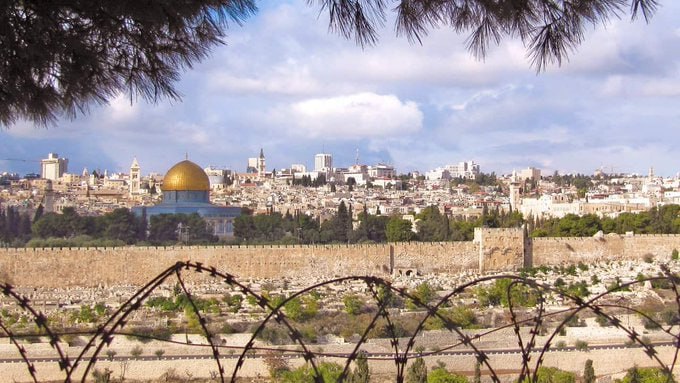
To understand what’s happening – the destruction of Gaza, the war with Iran, the rise of Temple Mount extremism inside Israeli politics, you have to understand the belief systems that helped shape this moment.
Some of those beliefs are ancient, rooted in Jewish prophecy, like the vision of a Third Temple described in the Book of Ezekiel. But what transformed these prophecies into a powerful geopolitical force wasn’t Jewish theology alone.
It was the way those prophecies were repackaged for Christian audiences and embedded into American Protestantism.
The turning point came with the Scofield Reference Bible, first published in 1909. Through extensive footnotes, it reframed the Bible through a dispensational lens, teaching millions of American Christians that biblical prophecy required the Jewish return to Israel and eventually the rebuilding of the Temple in Jerusalem.
According to this theology, the Second Coming of Christ could not occur until these events unfolded.
This interpretation spread through churches, seminaries, and evangelical networks, eventually shaping powerful political movements such as Christian Zionism. By the late twentieth century, millions of American evangelicals believed supporting Israel was not merely a political choice but a biblical obligation.
Groups like Christians United for Israel, led by figures such as John Hagee, turned that belief into organized political pressure in Washington.
But the origins of this theology raise deeper questions.
Cyrus Scofield himself was not a trained theologian. He was a former lawyer with a controversial past who somehow ended up producing the most influential annotated Bible in modern American history.
Scofield’s rise was supported by influential Zionist figures, including the wealthy New York lawyer Samuel Untermeyer, who allegedly helped position Scofield within elite circles and facilitate the publication and distribution of his Bible.
The outcome is undeniable; a specific theological framework took root in American Christianity, one that linked U.S. support for Israel to divine prophecy and the eventual rebuilding of the Temple.
Over the last two decades, that framework has begun to move from theology into political reality.
The Temple Mount movement inside Israel has grown significantly. Discussions of reclaiming the site have become more visible in Israeli politics. And preparations associated with ancient Temple rituals, including the breeding of red heifers for purification rites, have attracted international attention.
Amidst the ongoing war with Iran, Tucker Carlson has raised a scary possibility; could this war be the perfect opportunity for Israel to destroy Al Aqsa mosque, blame Iran for it and finally be able to build the Third Temple?
Whether or not that scenario ever materializes, the deeper point remains.
The political dynamics we are witnessing today did not emerge overnight. They are the product of a century-long fusion of theology, geopolitics, and strategic influence, a system in which prophecy was gradually translated into policy.
And once belief systems of that scale take root inside great powers, they have a way of shaping history in ways few people fully recognize until much later.
 Sunny's Journal