

After a stressful week that including having some major repair work done on an aging vehicle and a scamming attack, I decided I needed to decompress by visiting one of my favorite local state parks, Bulow Woods.
Sometimes when I climb into the Kia I really don’t know where I want to go. The “plan” formulates as I drive and often depends on conditions, availability of parking at some locations, weather, etc. I decided to head to Bulow Woods even as I was calculating on whether or not I would stop at the grocery store and then get some gas before returning home. I like to combine chores with outings so I use less gas. I’ve been doing this for years as second nature.
When I arrived at the tiny parking area for the middle portion of Bulow Woods I was in luck; there was a space for my car. Parking, I pulled on my hiking boots thinking the trail might still prove muddy in places. I really could have worn my Keen water sandals yesterday. The path heading towards Cisco Ditch was dry and crunchy underfoot as old dried leaves were falling like a light rain shower. There were distinct signs of the return of Spring to this ancient hammock forest, with bright green leaves on some of the maples.

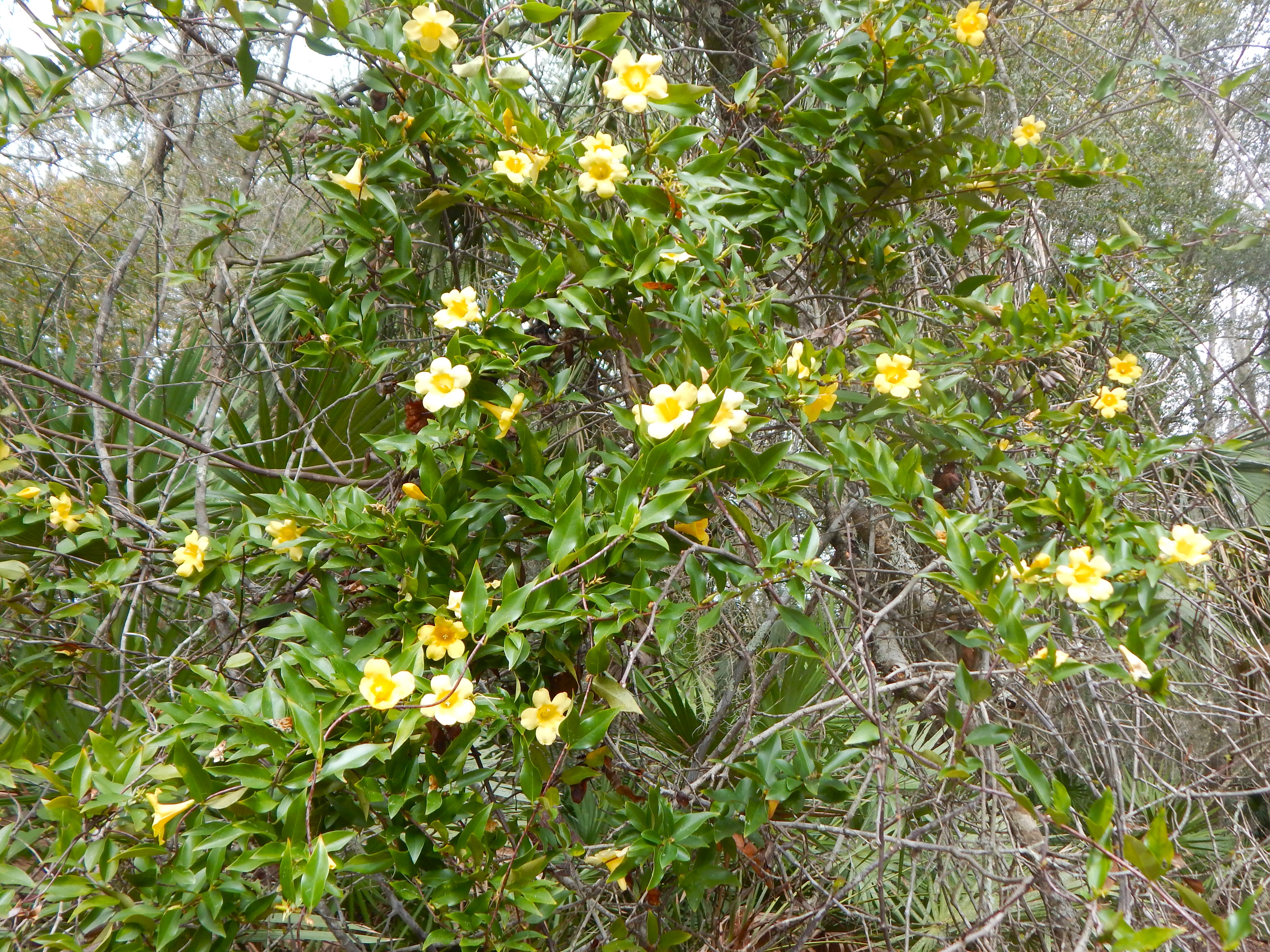
By now if you’ve been following these photo journals, you are aware of my love for plants. The Carolina Swamp Jasmine or Jessamine caught my eye as I was sauntering northwards on the trail. Typically the undergrowth in the hammock is stiff upright Yaupon Holly or bushy Inkberry Holly, but suddenly I noticed some yellow blossoms sprinkled on the damp grass. Looking upward, I was rewarded with this glorious native vine in bloom, its yellow trumpet-shaped flowers beckoning to fluttering white butterflies. Upon returning home, I looked up the plant and discovered it is a native that is used in gardens. There are some named cultivars. In the woods it sprawls around climbing with profuse evergreen tangles. It can bloom several times a year. Since the temperature was warmish (around 70 degrees F, 17.2 C) the flowers were out for display, adding a bit of charm to the dusty woods.
I continued on towards the bridge over Cisco Ditch, which is currently out-of-commission (more on that later). As I walked along the path I was admiring the girth of some of the older trees, trees that I couldn’t put my arms around and touch my fingers, so perhaps five feet or more in circumference. These are substantial specimens, primarily live oaks and maples. There are also Magnolia Grandiflora sprinkled throughout the woods, along with the spiky Sabal (Cabbage) Palms, Saw Palmetto and assorted shrubs. I’m still learning the natives here, as well as some of the invasives. As a note, when species, whether plant or animal are brought to Florida from another subtropical setting, they adapt quickly and become invasive. Case in point the boa constrictors that have taken over the Everglades.


While the trees I was passing off the trail are notable, the northern section of the trail (still off-limits) possesses some massive specimens. Years ago, I walked that section of trail a couple of times. There is a loop of about 5 miles that passes through the forest and edges one of the swamps that feeds into Bulow Creek. Gigantic ferns cover portions of this marsh. It is simply spectacular if you love subtropical jungles.

It’s difficult to photograph leaves in the midst of a forest. The lighting is dimmed due to the overhanging foliage and jumble of vines that comprise the canopy. I was attempting to capture the bright nearly chartreuse green of these leaves.

The bright blossoms and new leaves are in contrast to the dusty trunks of trees and vines against the dark tea-colored waters of Cisco Ditch.
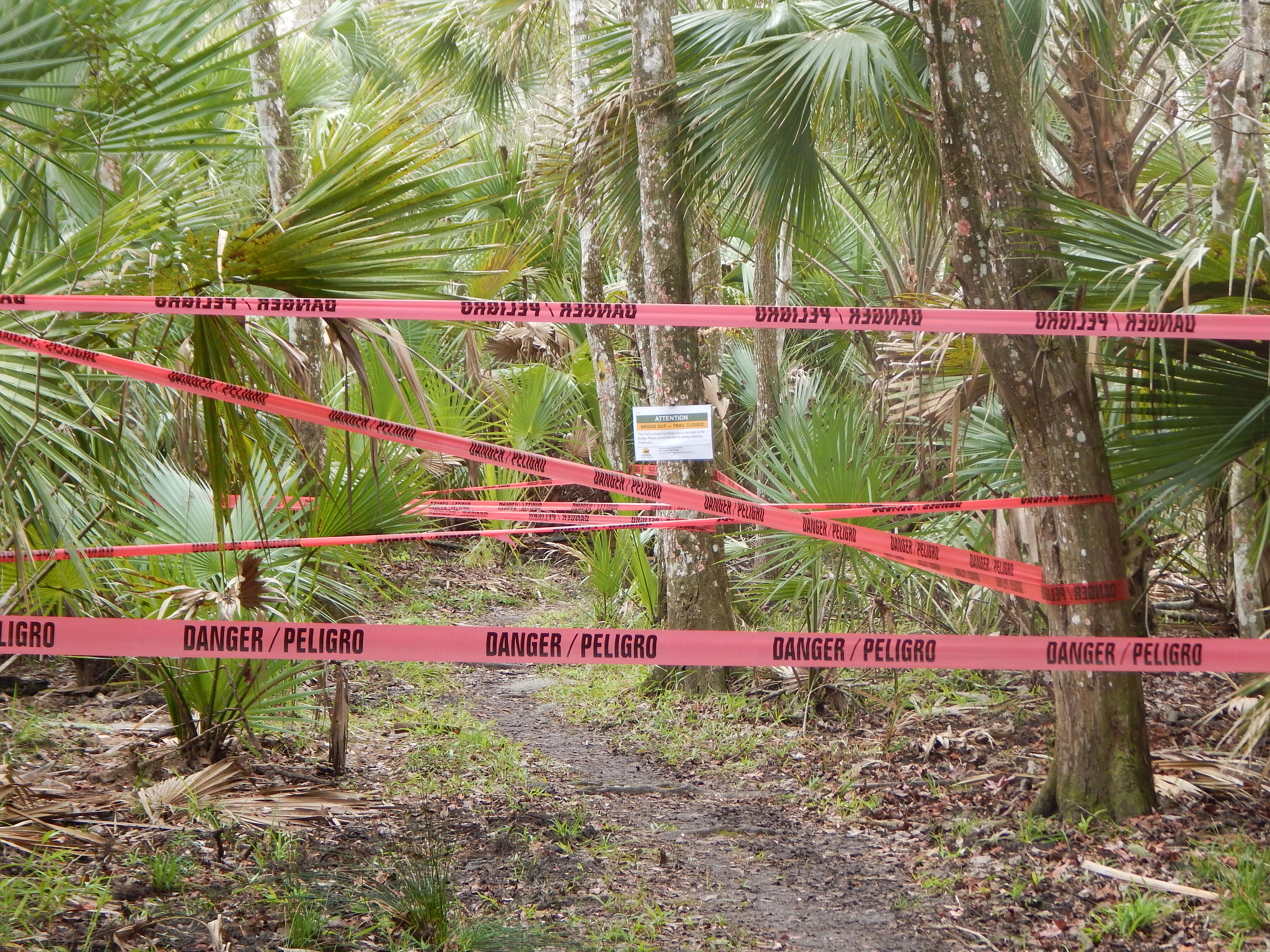
The pink tape was draped across the trail, blocking the approach to the old bridge. I encountered three rangers on the trail, two inside a park truck and later another one talking to some visitors on the trail. One of the rangers told me of their plans for the forest. The bridge has been fully removed and will be replaced. It would appear the rangers are in the process of gearing up for their repair program on the northern trail section. That part of the forest has not seen any work on it since Hurricane Ian passed nearby in 2022. Trees will have to be removed from the trail, bridges replaced, routes altered depending on what is found. I’m sure they have already done a great deal of survey work to determine what will be required.
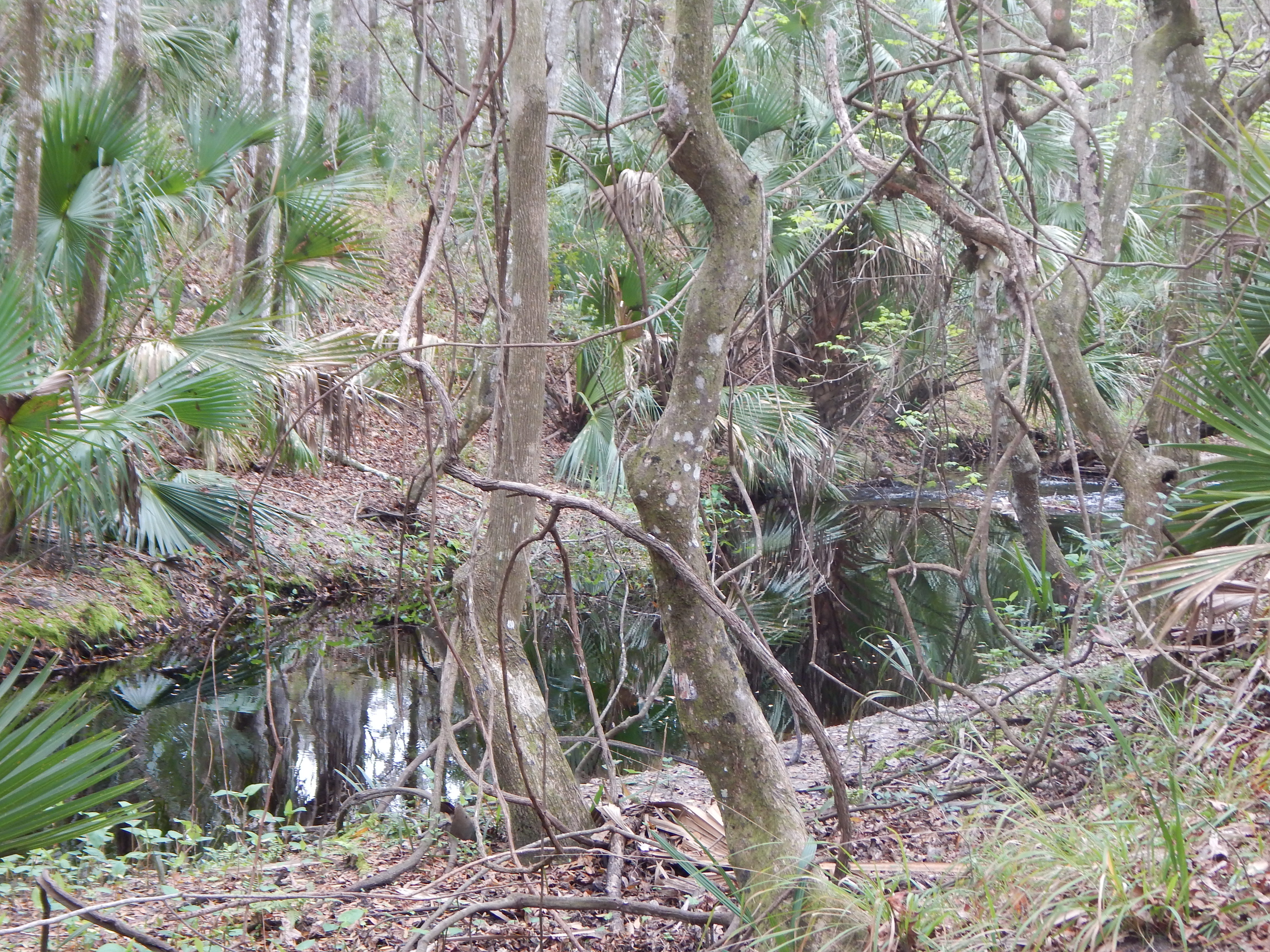

I finally reached the sandy/mud beach on Bulow Creek only to find someone else there ahead of me. Not wanting to disturb the individual, I snapped a few photos, but didn’t linger.
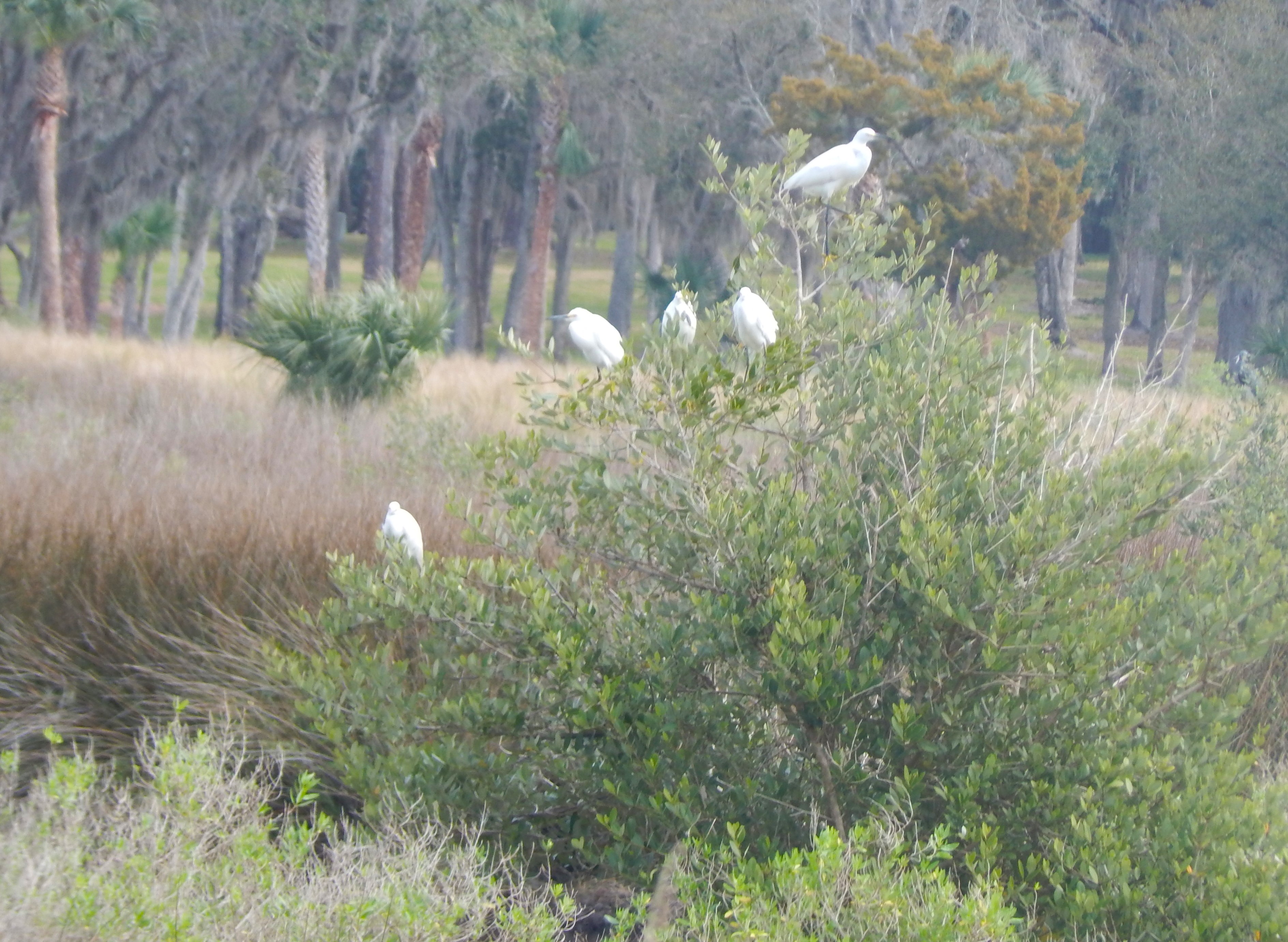
Whenever you approach water’s edge in these salt marshes, you encounter birds of all sorts, especially wading birds. Today I saw a raft load of egrets… or at least a bush load, as well as some individuals. There was a lot of bird activity high in the canopy, with the knocking rhythm of woodpeckers, the cry of an unseen osprey, the song of mockingbirds and other unidentifiable songsters. It is nearly impossible to sight a bird perched high up in a hundred foot pine tree unless it is fluttering about.

The sun was playing peek a boo periodically during the hours I spent on the trail. Clouds were building up on the horizon (when it could be seen) as we were expecting a drenching rainstorm on Saturday and Sunday.
Upon returning to the car, I decided to continue on to my favorite little peninsula on Bulow Creek, so I re-entered the middle portion of the trail, heading south. There I encountered two rangers in one of their jeeps. I had a long chat with the guys who informed me of their plan to hold a controlled burn on that section of trail. The area has not had a burn for at least ten years and even I, a relative newcomer to Florida, know that at least 4 to 5 hurricanes have passed through the area since then. The mature forest has too much flammable material and as the ranger noted is subject to periodic forest fires if not cleaned up. The saw palmetto will grow back, while the older trees will be blackened at their bases, but not heavily affected by the quick fires as it consumes the piles of fallen leaves, branches, palm fronds etc. off the forest floor. Having noticed burn marks on some of the older trees before, this explanation connected some dots for me on how the state manages this particular forest.

I later encountered another ranger speaking with some visitors. One of the men, a young burly fellow, was volunteering to help with some of the clean up, making the ranger feel very happy. These guys love their work and their woods.
I kept encountering all sorts of friendly visitors along the route, including people walking their dogs. Two of the dogs, both Miniature or Pocket Pitbulls, came up to me wiggling their little bottoms. I’m a dog magnet sometimes and these short-legged grinning Pitbulls are very sweet creatures, pulling at their leads the moment they saw me.
When I finally reached the peninsula, again I wasn’t alone. Two people had beached their kayaks and were eating lunch perched above the creek. We chatted; the couple were visiting the area from Miami. They were concerned they were on private land, but I assured them they were on state park lands.
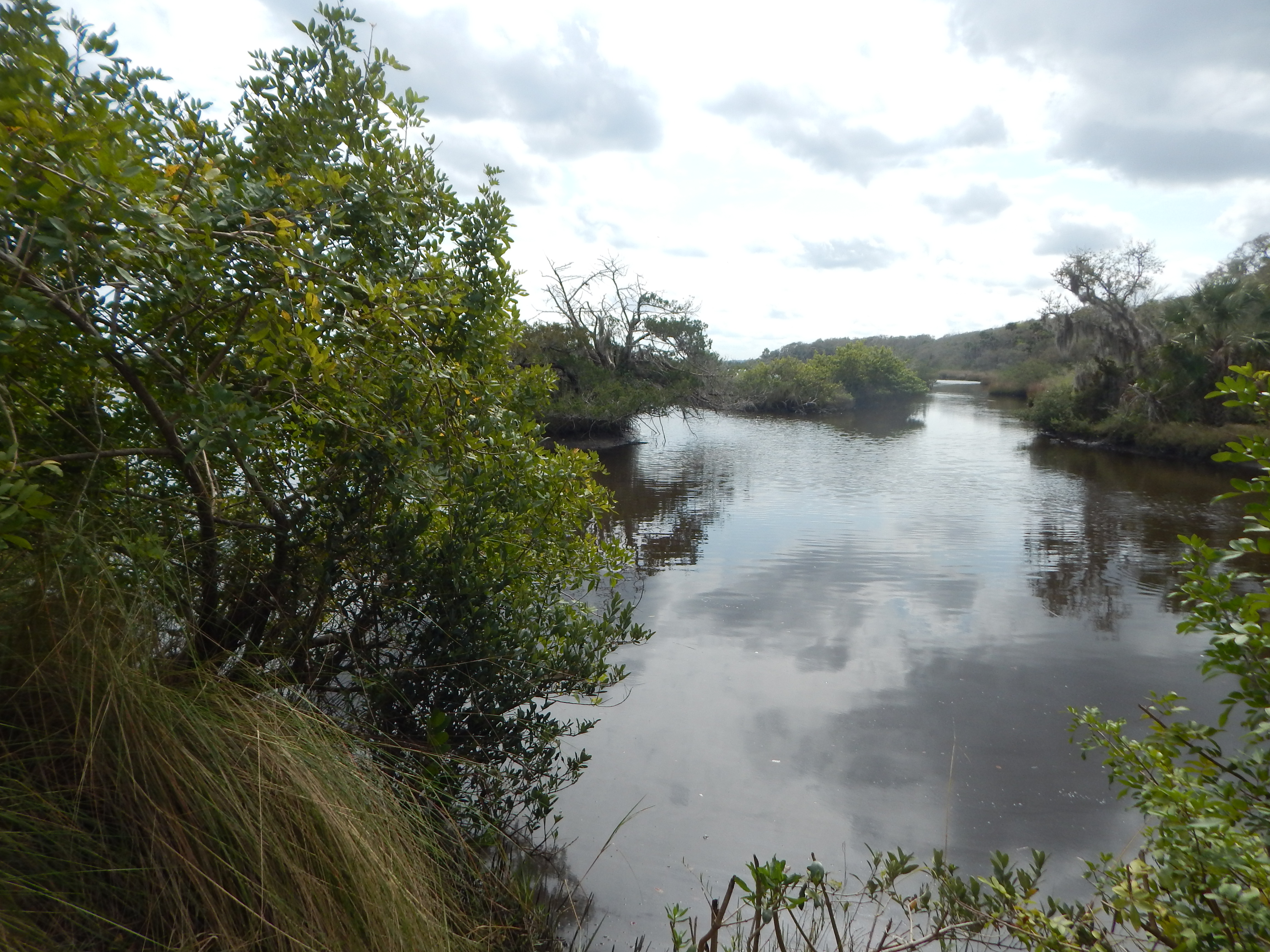
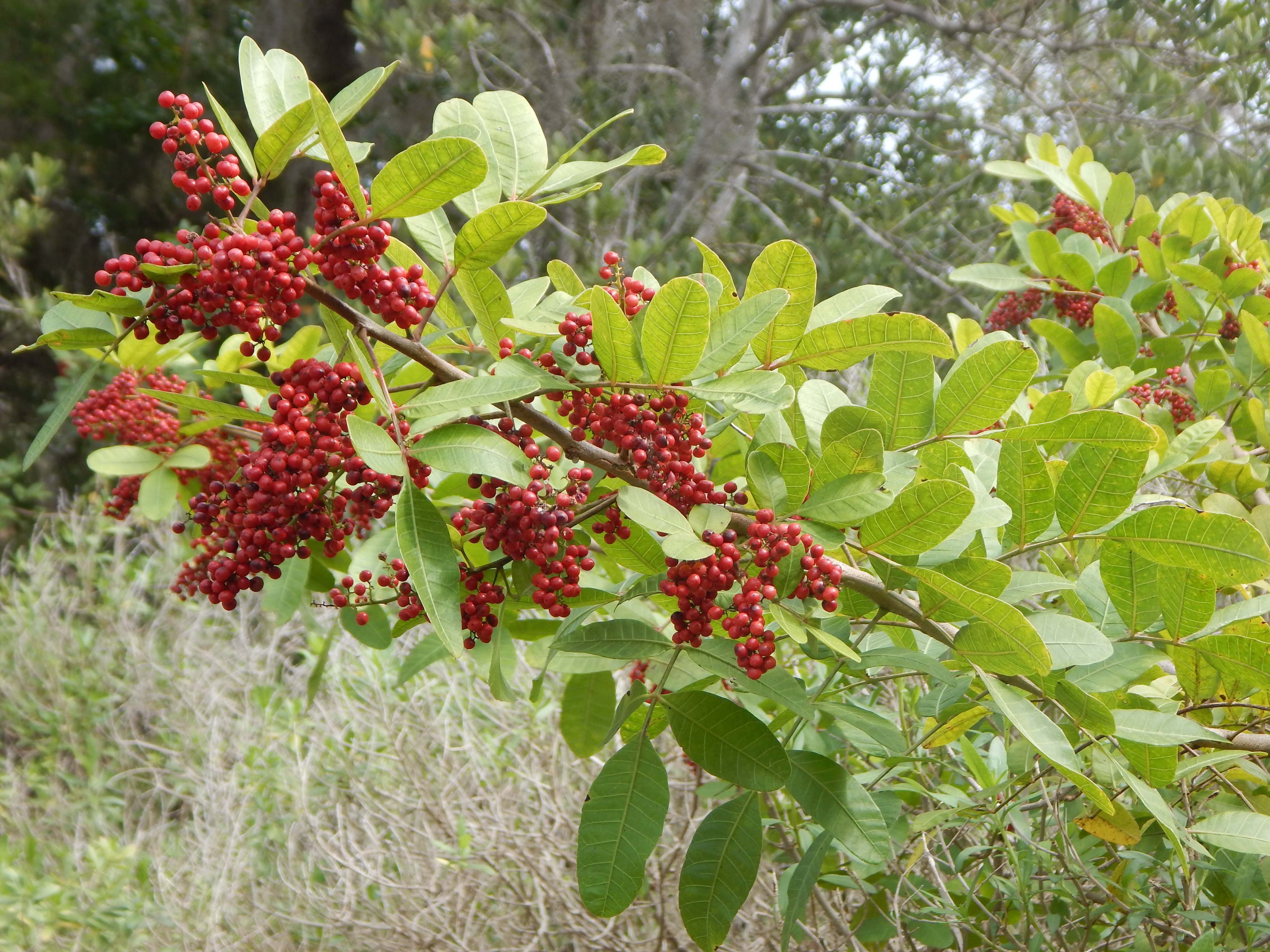
After doing some research, I’ve identified this handsome plant as Brazilian Pepper, which was brought to Florida in the 1980’s as an ornamental. Unfortunately, the pepper proved to be prolific and has spread into some of the salt marshes. I have seen in along Bulow Creek and again at Betty Steflik Preserve. It does make a beautiful hedge and as you can see possesses beautiful red berries.
https://en.wikipedia.org/wiki/Schinus_terebinthifolia
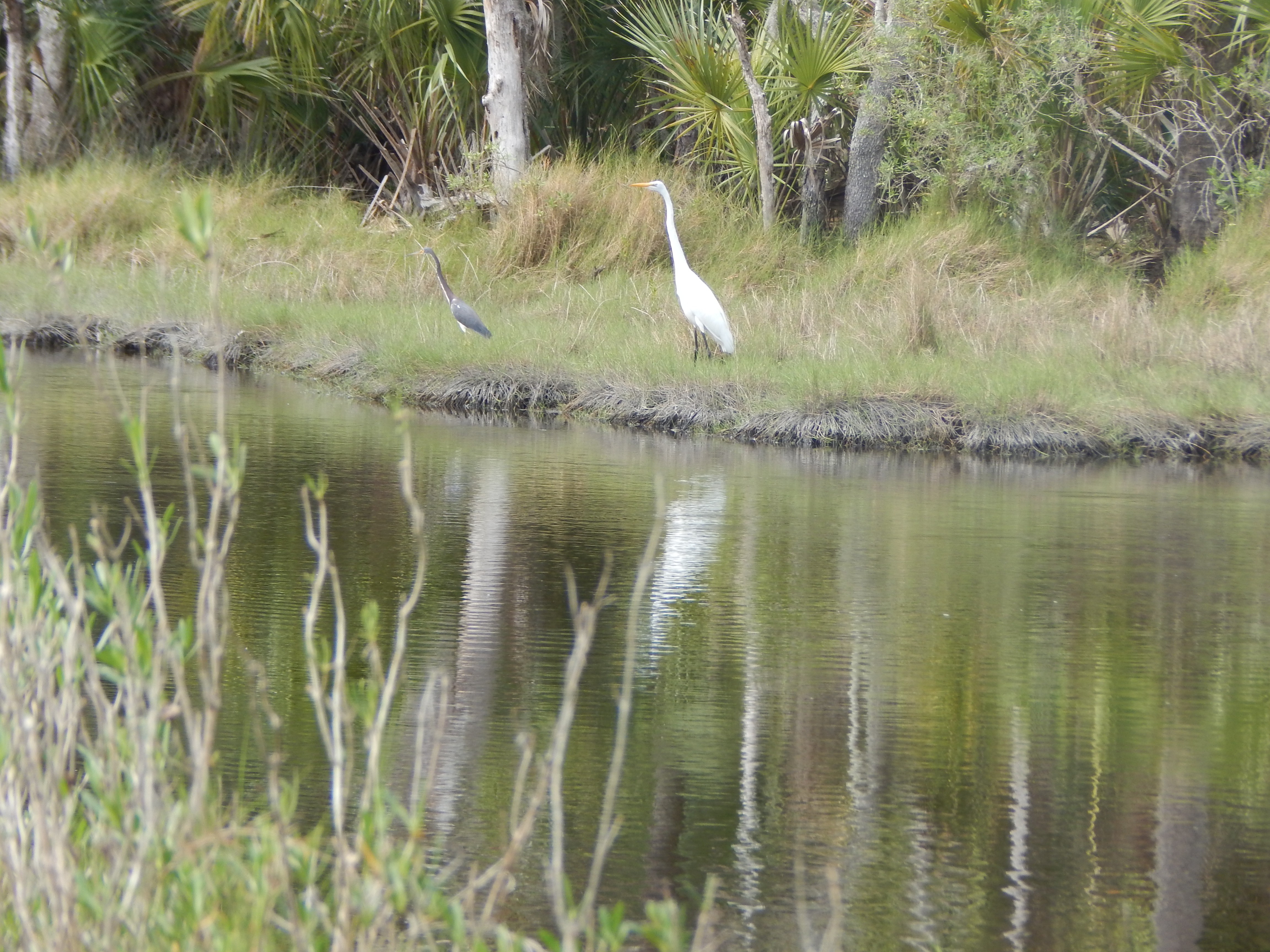
All in all, it was a pleasant forest walk on a warmish day without the usual mozzies (mosquitoes and gnats).
After finishing up my walk, I loaded myself into the car and drove to one of the local grocery stores for some provisions and later got some gas for the Kia. I felt tired but refreshed from my physical activity and being immersed in one of my favorite spots in Florida, Bulow Woods. I had accomplished quite a bit, gathering intel on the forest, doing some plant ID, chatting with other visitors, and greeting other walkers and bicyclists on the trail. A good day.
Eliza
COMMENTS ON
 Sunny's Journal