
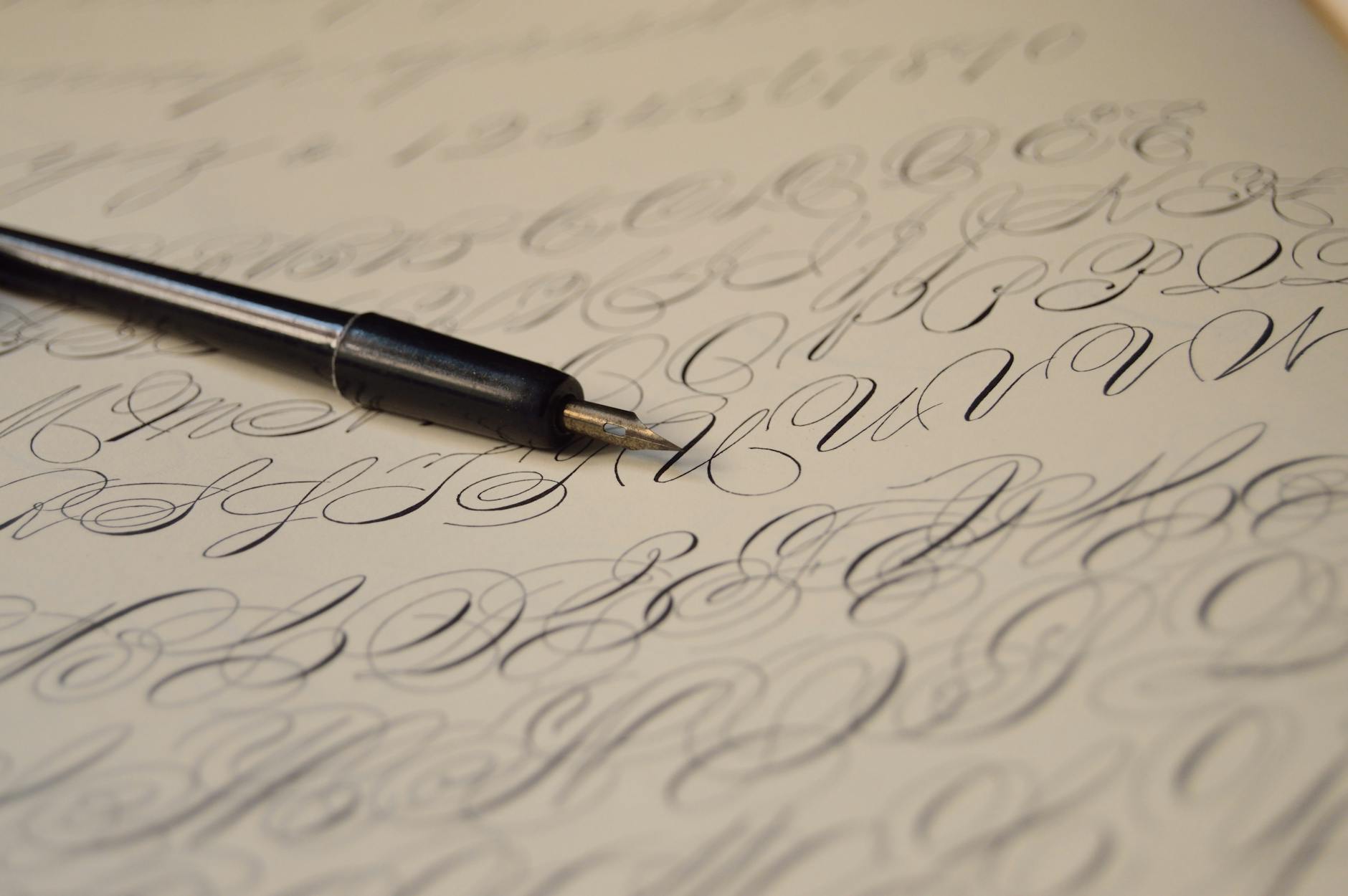
They did not take cursive from the schools because children no longer needed it. They took it because of what it was quietly building in them.
Consider what the exercise actually is. A child, six years old, is handed a pen and asked to draw a single unbroken line that becomes a word. The wrist must float. The fingers must hold a living pressure, never quite the same twice, always correcting. The eye must follow the ink forward and trust the hand to finish what it has begun. There is no lifting, no stopping, no starting over mid-word. The loop must close. The ascender must rise and return. The sentence must travel from one margin to the other as a single continuous gesture, and at the end of it the hand must still be steady.
Twelve years of this. Every day. Ten thousand small acts of sustained, self-correcting attention, carried out below the level of conscious thought, until the motion belongs to the body and the body belongs to the motion.
This is not penmanship. It is the slow construction of an interior form.
The hand that has learned to carry a line without breaking it is the hand of a mind that has learned to carry a thought without breaking it. The two are not metaphors for one another. They are the same faculty, trained in the same child, by the same daily discipline. Continuity of the stroke becomes continuity of the reasoning. The patience of the loop becomes the patience of the argument. The commitment to finish a word one has started becomes the commitment to finish a sentence, a paragraph, a life’s idea, without reaching for the nearest distraction halfway through.
Print is a different creature entirely. Print lifts. Print stops. Print assembles a word out of separate, stamped, interchangeable pieces, each one beginning and ending in isolation. A mind raised only on print learns to think the way print is made, in discrete tokens, in replaceable units, in fragments that can be recombined by any outside hand without the owner noticing the substitution. It is precisely the shape of thought a language model produces. It is precisely the shape of thought a language model can steer.
Cursive is kata. This is the whole of it. A form repeated daily, for years, not for the sake of the form but for what the repetition lays down in the practitioner beneath the form. The swordsman does not train kata so that one day he may fight in kata. He trains it so that when the moment comes and there is no time to think, the movement is already inside him, older and deeper than thought, and it rises on its own. Cursive was the kata of the literate mind, the daily quiet drilling of continuity, of patience, of a line held steady under the long pressure of its own length. And the signature it produced at the end, that small flourished mark unique to a single human being on earth, was only the outward proof of an inward form no machine and no other hand could ever reproduce.
Take the kata away and the practitioner is left with vocabulary in place of faculty. He can recognise a whole thought when he encounters one. He cannot carry one himself. He can admire a finished argument. He cannot sustain one long enough to close its loop. He begins books he does not finish, sentences he does not end, ideas he abandons the moment the screen in his palm offers him a brighter one. And when the machine begins feeding him tokens in the exact shape his schooling taught him to receive, he meets it with no interior resistance at all, because no interior form was ever built in him to push back with.
They removed it quietly, across a generation, and they removed it in the last years before the machines arrived. Twelve years of daily practice in unbroken, embodied, self-authored thought, gone from the curriculum of almost every child in the Western world, just as the instruments designed to complete their sentences for them came online.
The hand forgets. The mind, having never been taught the kata, forgets a thing it never knew it had.
That is what cursive was. That is what was taken. And that is why the thought of anyone who still writes by hand, in long unlifted lines, remains, quietly, stubbornly, and without their ever needing to announce it, their own.
Now the question stands open. What else has been banned, phased out, quietly retired from the curriculum and from common life over these same decades, under the same soft excuses? Mental arithmetic. Memorisation of poetry. Latin. Logic as a formal subject. Map reading. Knot work. The keeping of a commonplace book. The reading aloud of long passages in class. Singing in parts.
What was each of those actually building in the child, beneath the surface of the lesson, and whose interest was served by its disappearance?
https://x.com/SiriusBShaman/status/2046598024525136380
Notes to Readers:
Read the comments attached to the X post. Very enlightening.
Personally, I feel everything removed by the so-called Department of Education, should be reinstated. This would put pressure on schools to actually hire qualified educators, not programmed communist ideologists.
A lot of learning has been lost during the past 40 to 50 years.
Eliza
 Sunny's Journal