
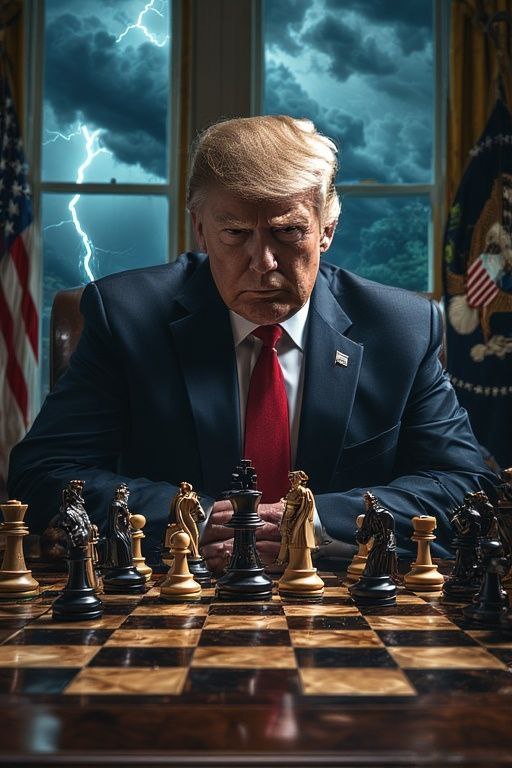
Trump Was Right All Along
Donald Trump’s core claim about trade and industrial policy was simple and unfashionable: trade is a tool of national power, not an end in itself. The last year has gone a long way toward proving him right.
The damage was done when China was accepted into the WTO and then implemented mercantilist trade practices while global technocrats sat idle. The bet was that China’s integration into the rules-based system would liberalize its politics and normalize its economics.
Instead, subsidized overcapacity, managed exchange rates, and aggressive export targeting gutted large parts of U.S. manufacturing and weakened the broader Western industrial base. What elites treated as efficient globalization was, in practice, the offshoring of productive capacity, the hollowing out of industrial regions, and the strategic empowerment of a geopolitical rival.
That insight shaped everything that followed. Trump argued that the era of frictionless globalization was over, that trade deficits and supply-chain dependence mattered, and that national strength would again rest on productive capacity, industrial depth, and control over strategic resources.
Trump’s America First strategy, anchored in the Hamilton–Clay tradition, treated tariffs, trade reviews, and infrastructure as instruments of statecraft. That was dismissed as crude protectionism. It now looks like early recognition of the world we’re actually in. Operation Epic Fury made the geopolitical point even more starkly: Pax Americana is dead.
The evidence is now coming not just from Trump’s allies but from the broader political and intellectual class. Even Paul Krugman has conceded that “conditional tariffs” on Chinese cars are “probably going to be necessary” and warned that Europe cannot allow its auto industry to be hollowed out by Chinese overcapacity. When a progressive Nobel laureate starts agreeing with Trump that tariffs and industrial capacity have a legitimate strategic role, the old consensus is gone. The argument now is no longer over first principles, but over how far and how fast to move.
That shift is showing up in North America as well. The Trump administration’s refusal to extend the current trade pact on existing terms codified what Trump’s worldview had already implied: the age of automatic continental trade management is over. The agreement remains in force, but it is now under deliberate strategic review. Trade is being judged less by abstract efficiency and more by whether it strengthens industrial depth, energy security, and continental resilience.
Canada is now being forced to adjust.
The next round of U.S.–Canada trade talks should deepen integration where it already makes strategic sense, energy, critical minerals, power, and industrial inputs—while targeting the old protected zones of the Canadian economy where reciprocity with the United States still does not meaningfully exist: supply‑managed agriculture, softwood lumber, sheltered finance, and telecom. Canada’s dependence on U.S. downstream refining capacity for heavy crude shows how real continental interdependence already is, while its openness to subsidized Chinese EV imports underscores the same danger Krugman identified in Europe: allowing Chinese overcapacity to hollow out domestic industry.
Trump saw that first. He understood before most of the establishment that the global economy was shifting from efficiency to security, from comparative advantage in the abstract to productive capacity in the real world. Now even his critics are conceding the point. The only serious question left is whether governments are prepared to act on what Trump understood long before they did.
7:21 PM · Jul 4, 2026
~T edit: Thats because Trump is a very shrewd businessman, a tycoon, who understands actual economics, not just ability to spell economics. You know, I voted for Ross Pero in the 90’s for that very reason. And I hated [clinton] and everything about him. I served then, too. What was not to hate?
The media clowns know nothing of economics either.
Notes to Readers:
Few Americans understand economics unless they’ve been educated into the business. This has been intentional.
When I took a Business Math class in Junior College (going for a third degree…) I learned about interest rates, etc. and how much of it is actually fraud. Most people don’t understand the concept at all.
I observed American factories being outsourced to places like China and SE Asia and saw once Made in America goods traded for plastic rubbish that falls apart.
Trump knows. He’s smart, a business man with an intelligence that is higher than most Americans or anyone else for that matter. Not just IQ, but also street smarts, learned from having to deal with Mafia-controlled unions while working in NY City and State.
You may not like the man, but you have to admire his persistence in bringing back business to the United States. It’s not just a matter of finance; it’s a matter of national security. Being less dependent on other nations, especially ones like CCP-controlled China (actually controlled by the Mossad / CIA) and American-hating Europeans.
Under the Trump administration, we’re all getting an education on economics, geography, finance, and history, all subjects seldom addressed in today’s “progressive” education settings (translation: Communist indoctrination).
Eliza Ayres
Sunny’s Journal, https://sunnysjournal.com
 Sunny's Journal