
This “Harvard Narrative” is just the beginning… Harvard dates back to 1636… but the architecture wrapped around institutions like it was already centuries in the making… a thread 🧵
Follow this thread far enough and education stops looking like a collection of schools and starts revealing itself as strategic infrastructure… the place where legitimacy is manufactured, expertise is credentialed, research is financed, technology is developed, networks are formed and influence moves downstream into government, finance, medicine, media, industry and national power…
Harvard is not the whole story… it is the doorway that opens the timeline wide enough to see the system behind it… over the past three years I’ve written over a dozen articles tracing pieces of this architecture… Harvard, foreign funding, Confucius Institutes, research access, talent pipelines, federal grants, technology transfer and downstream placement…
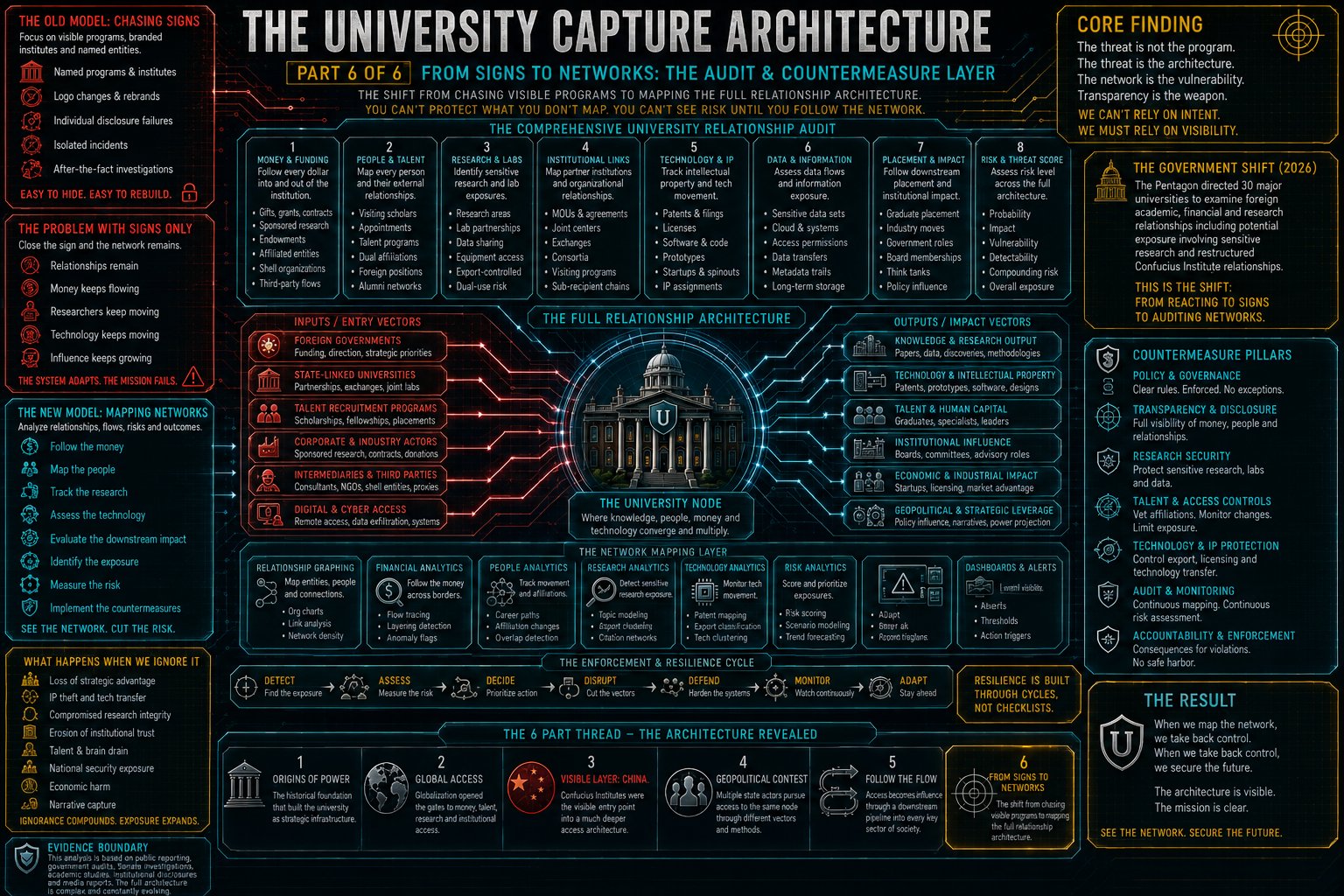
Let’s dive into the The University Capture Architecture… a 7-part thread…
2/ Let’s start with the origins of power… universities have always sat close to power because education has never been only about transferring knowledge… it determines who is recognized as credible, who is trained to administer institutions, who interprets law and medicine, who receives access to elite networks, and ultimately who is permitted to shape the direction of society…
Go back centuries and the pattern is already visible… medieval universities developed beside church and crown, educating clergy, lawyers, physicians, scholars and administrators who moved directly into the institutions governing society…
Knowledge created legitimacy… legitimacy created authority… authority created placement… as nation-states strengthened through the 18th and 19th centuries, universities became engines of national science, professional expertise and state capacity, increasingly producing the people who staffed government, industry and the expanding administrative class…
Then war changed the scale… WW1 tightened the relationship between science and government… WW2 fused universities directly into the national security architecture as laboratories, mathematicians, physicists, engineers and physicians became strategic assets…
Let’s map them… radar, nuclear research, computing, medicine, communications and advanced materials were no longer simply academic pursuits… they were capabilities capable of determining the outcome of wars…
The Cold War locked that transformation into place… federal research money poured into American universities… laboratories expanded… government agencies built permanent relationships with campuses… defense, aerospace, computing, medicine and advanced science became deeply intertwined with university research…
That was the inflection point… the university was no longer simply a place where knowledge was taught… it had become infrastructure through which knowledge was produced, credentialed, financed, weaponized, commercialized and distributed into the institutions governing modern civilization…
Once that happened, access to the university meant access to far more than classrooms, it meant access to the machinery producing the future… more…
3/ Globalization opens the architecture… once universities became strategic infrastructure, globalization changed who could reach them…
The same openness that made American universities extraordinary… international collaboration, scientific exchange, foreign students, visiting scholars, joint research, private philanthropy and global academic partnerships… also created thousands of legitimate pathways through which money, people, technology and institutional relationships could cross borders…
That openness became one of America’s greatest strengths, and one of the most valuable access points in the geopolitical system…
Foreign governments no longer needed to reproduce the entire American research ecosystem domestically to benefit from it…. they could build relationships with universities already sitting atop federal grants, advanced laboratories, world class faculty, intellectual property, corporate partnerships and enormous alumni networks…
The flows multiplied… foreign gifts could create institutional relationships… academic partnerships could create researcher exchanges… visiting scholars could enter advanced laboratories… joint research could connect scientists across borders… talent programs could recruit specialists… international students could acquire expertise and credentials… corporations could sponsor university research… and technology transfer offices could convert discoveries into patents, licenses and startups…
None of those mechanisms is inherently improper… they are also precisely why universities became such high value geopolitical nodes…
The same institution might simultaneously receive funding from the Department of Defense, NIH, NSF and private industry… operate advanced laboratories… host foreign researchers… partner with overseas universities… license intellectual property… launch companies… and graduate people who move directly into government, defense, technology, medicine and finance…
That concentration is extraordinary… globalization did not create the university power structure, it opened the gates around an infrastructure already built over centuries, and once those gates opened, the geopolitical contest shifted…
The question was no longer simply who could build the best university… it became who could gain access to the universities that already concentrated the world’s most valuable research, technology, prestige and human capital…
That is where the modern architecture begins to accelerate… more…
4/ China becomes the most visible modern layer, they did not invent this architecture…
China learned how to use it at scale… Confucius Institutes became the most recognizable public face of that strategy because they placed Chinese government supported academic programs directly inside universities around the world…
They began expanding internationally in 2004… by 2011 more than 70 were operating in the United States… and by 2019 roughly 100 existed across American colleges and universities, backed by more than $150 million in Chinese government support documented by Senate investigators…
That was the visible layer… but the deeper relationship between China and Western academia extended far beyond language and cultural centers…
Chinese universities entered research partnerships with American institutions… visiting scholars circulated through laboratories… talent recruitment programs targeted scientists and specialists… foreign gifts and contracts created financial relationships… joint research connected researchers across borders… and technology transfer concerns increasingly drew the attention of federal agencies…
The strategic logic was straightforward… American universities sat on top of enormous concentrations of taxpayer funded research, advanced laboratories, scientific expertise and prestige… China was simultaneously pursuing rapid advancement in AI, semiconductors, quantum computing, biotechnology, aerospace, advanced materials and other strategic sectors…
Those systems inevitably intersected… that is why the disappearance of Confucius Institute signs never meant the underlying geopolitical question disappeared…
By 2023 fewer than five traditional Confucius Institutes remained in the United States… yet scrutiny increasingly shifted toward the relationships behind the branding… successor programs, former partner universities, talent programs, foreign appointments, research collaboration, funding disclosure and intellectual property exposure…
That shift reveals the larger lesson… if you map only organizations, the system can disappear when an organization changes its name… if you map relationships, the architecture remains visible…
The mapping is simple… money… researchers… laboratories… agreements… technology… credentials… alumni networks…
Those are the durable pathways… Confucius Institutes became important because they gave investigators something visible to examine, but the larger discovery was that the sign on the building was never the whole network…
It was simply the first layer that became impossible to ignore… more…
5/ The geopolitical contest… once the architecture becomes visible, the China story immediately expands into something larger…
The modern university is now one of the most valuable junctions in geopolitical competition because it concentrates exactly what states compete hardest to acquire… knowledge, technology, researchers, laboratories, intellectual property, prestige and highly trained human capital…
China represents the largest and most extensively documented modern pressure vector… but it is not the only state operating inside the broader research security environment…
Russia brings a different historical profile built around mathematics, physics, nuclear science, aerospace, engineering and cyber capability… areas where academic knowledge can quickly translate into strategic capacity…
Iran’s interests intersect heavily with engineering, materials, aerospace, nuclear related science and other dual use technologies…
North Korea has far less direct academic presence in the United States, yet still sits inside federal foreign country of concern frameworks because technology and expertise can move through intermediaries, third countries and indirect relationships…
Different states, different methods, same strategic prize, and that prize is not simply a diploma… it is access to the knowledge production infrastructure of the United States…
An advanced university laboratory can sit simultaneously inside multiple systems… federal science funding, defense research, biomedical development, private industry, international collaboration and technology commercialization…
A single professor can participate in academic research, advise industry, train graduate students, collaborate internationally and contribute to federally funded projects… and a single research program can produce papers, datasets, patents, startups and highly trained specialists who eventually disperse across the economy…
That is extraordinary leverage concentrated inside one node… this is why federal research security policy increasingly treats universities as part of national infrastructure rather than isolated educational institutions…
The contest is therefore much larger than ideological influence… it touches the technological foundations of national power…
This mapping is also easy to see… AI… quantum… semiconductors… biotechnology… aerospace… cyber… nuclear science… energy… advanced materials… and medicine…
These are not simply academic fields anymore, they are the building blocks of economic and military capability, and whoever gains durable access to the people and institutions producing those capabilities gains leverage far beyond the campus… more…
6/ Let’s follow the flow… this is where the architecture stops looking theoretical…
Foreign money enters through gifts, contracts, sponsored research and partnerships… researchers move through visiting appointments, fellowships, joint projects and talent programs… laboratories connect through collaboration agreements… ideas become papers… papers become patents… patents become companies… credentials move people into positions of authority… and relationships formed inside universities follow those people for decades…
The university acts as the conversion point… let’s track it… money becomes access… access becomes knowledge… knowledge becomes technology… technology becomes capability… credentials become placement… placement becomes influence… and the outputs spread everywhere…
Graduates move into government agencies where policy is written… defense contractors where national-security systems are built… technology companies controlling communications and data… hospitals and pharmaceutical companies shaping medicine… financial institutions allocating capital… media organizations defining public understanding… think tanks producing policy frameworks… corporations managing global supply chains…
That downstream movement is why universities are so crucial… their influence does not remain inside the university… it leaves through people, technology, institutions, intellectual property, and once those flows become embedded across hundreds of organizations, the original relationship can become almost invisible…
Let’s look at how this plays out… a researcher trained today can lead a laboratory twenty years from now, a graduate student can become a cabinet official, a university startup can become critical infrastructure, a scientific partnership can become a commercial supply chain, and an academic network can become a policy network…
That is how institutional systems compound… this does not require every actor to share an agenda or every relationship to be malicious… complex systems become powerful precisely because thousands of independent actors can move through the same channels for different reasons while still reinforcing the same underlying architecture…
That is why the correct question is no longer simply…
“Who has access to the university?”
The deeper question is…
“What does that access become once it moves downstream?”
Follow the flow long enough and the university stops looking like the endpoint, it becomes the launch point… more…
7/ From signs to networks… now the architecture reaches the present timeline… let’s take a look at this, together…
For years governments focused heavily on visible organizations… Confucius Institutes, named talent programs, specific foreign partnerships, individual disclosure failures…
Those were necessary targets because they provided identifiable nodes, but the research security model is now changing…
By 2023 fewer than five traditional Confucius Institutes remained in the United States… yet federal scrutiny continued expanding because investigators increasingly understood that closing a branded organization does not necessarily eliminate the relationships, researchers, funding channels or institutional partnerships that existed around it…
Then came the next step… in 2026, the Pentagon ordered 30 major American universities to examine foreign academic, financial and research relationships… including potential exposure involving sensitive or export controlled research and organizations associated with restructured Confucius Institute relationships…
That is a profound shift in method, the old model searched for the sign, the new model maps the network…
Who supplied the money… which foreign institution entered the relationship… which researcher held an outside appointment… which laboratory was involved… which federal grant funded the work… what data was shared… what intellectual property emerged… where the researcher moved… what company commercialized the technology… which government or institution ultimately gained capability…
That is systems level visibility, and once government begins analyzing universities this way, the architecture becomes much harder to hide inside organizational complexity…
The thread comes full circle… centuries ago universities produced clergy, lawyers, physicians and administrators for church and crown… industrialization turned them into engines of national science… war fused them with the state… federal investment transformed them into research powerhouses… globalization opened them to the world… foreign states recognized their strategic value… and now the United States is beginning to examine the resulting network at the level of relationships rather than logos…
That is the awakening arc beneath this entire story… first you see the institution… then you see the connections… then you see the flows… then you understand the system…
The University Capture Architecture was never hiding because nobody could see the universities… it was hiding because almost nobody was looking at everything connected to them at once…
Until now…
~ Observing Consciousness
https://i.fixupx.com/i/status/2089741813691105679
 Sunny's Journal