

𝐓𝐇𝐄 𝐆𝐑𝐄𝐀𝐓 𝐑𝐄𝐖𝐈𝐑𝐈𝐍𝐆
𝐇𝐨𝐰 𝐎𝐧𝐞 𝐆𝐞𝐧𝐞𝐫𝐚𝐭𝐢𝐨𝐧 𝐋𝐨𝐬𝐭 𝐭𝐡𝐞 𝐎𝐮𝐭𝐝𝐨𝐨𝐫𝐬, 𝐅𝐨𝐮𝐧𝐝 𝐭𝐡𝐞 𝐏𝐡𝐨𝐧𝐞, 𝐚𝐧𝐝 𝐆𝐫𝐞𝐰 𝐔𝐩 𝐀𝐧𝐱𝐢𝐨𝐮𝐬
There’s a photo that goes viral every few months: a pack of 1980s kids on bikes, no helmets, no parents, gone till the streetlights came on, set against a 2025 living room where four children sit silent, each lit by a screen. The caption asks what happened.
Like most memes, it’s half right. Which is the most dangerous kind of right.
Two things are true at once. Today’s kids are the most physically protected in human history. And by nearly every mental-health measure we track, they are the most anxious, depressed, and lonely cohort ever recorded. So let’s do what the meme never does: run the actual numbers, line them up by decade, and ask what really changed.
𝐅𝐢𝐫𝐬𝐭, 𝐭𝐡𝐞 𝐜𝐥𝐢𝐟𝐟
Adolescent mental health didn’t slide. It fell off a ledge, and the ledge has a date.
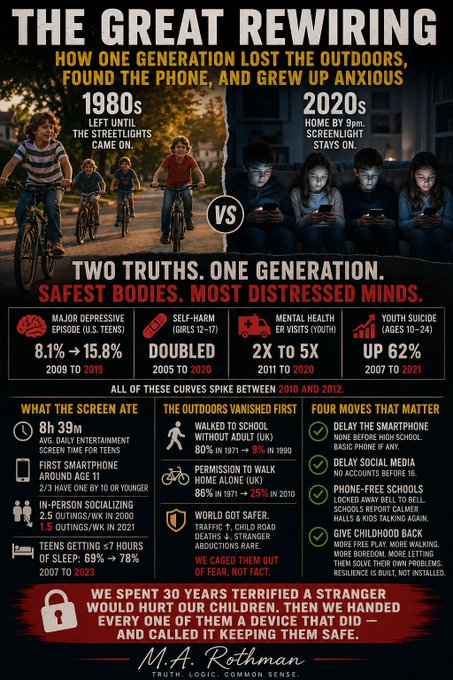
From 2009 to 2019, the share of U.S. teens with a major depressive episode nearly 𝐝𝐨𝐮𝐛𝐥𝐞𝐝, 𝟖.𝟏% 𝐭𝐨 𝟏𝟓.𝟖%. Self-harm among girls 12 to 17 𝐝𝐨𝐮𝐛𝐥𝐞𝐝 between 2005 and 2020. Pediatric ER visits for mental-health emergencies rose 𝐭𝐰𝐨- 𝐭𝐨 𝐟𝐢𝐯𝐞𝐟𝐨𝐥𝐝 from 2011 to 2020. And youth suicide (ages 10 to 24), flat from 2001 to 2007, then jumped 𝟔𝟐% 𝐟𝐫𝐨𝐦 𝟐𝟎𝟎𝟕 𝐭𝐨 𝟐𝟎𝟐𝟏 — for girls 15 to 19 it doubled in eight years, to the highest level since at least 1975.
Every one of those curves bends in the same narrow window: roughly 𝟐𝟎𝟏𝟎 𝐭𝐨 𝟐𝟎𝟏𝟐 — exactly when the smartphone went from luxury to default and the front-facing camera turned every teenager into the unpaid brand manager of a product that was themselves.
𝐖𝐡𝐚𝐭 𝐭𝐡𝐞 𝐬𝐜𝐫𝐞𝐞𝐧 𝐚𝐭𝐞
The average American teen now spends about 𝟖 𝐡𝐨𝐮𝐫𝐬 𝟑𝟗 𝐦𝐢𝐧𝐮𝐭𝐞𝐬 𝐚 𝐝𝐚𝐲 on entertainment media — not counting schoolwork. Tweens clock over five. The typical child gets a first smartphone around age 𝟏𝟏, and in the newest surveys nearly two-thirds have one by 10 or younger.
That time came from somewhere. In-person socializing collapsed: the typical eighth grader went from about 𝟐.𝟓 𝐬𝐨𝐜𝐢𝐚𝐥 𝐨𝐮𝐭𝐢𝐧𝐠𝐬 𝐚 𝐰𝐞𝐞𝐤 𝐢𝐧 𝟐𝟎𝟎𝟎 𝐭𝐨 𝟏.𝟓 𝐛𝐲 𝟐𝟎𝟐𝟏, the steepest drop starting around 2010. Sleep cratered too — teens getting seven hours or less rose from 𝟔𝟗% 𝐢𝐧 𝟐𝟎𝟎𝟕 𝐭𝐨 𝟕𝟖% 𝐢𝐧 𝟐𝟎𝟐𝟑.
Less time with friends. Less sleep. More screen. That’s the new childhood in three lines.
𝐓𝐡𝐞 𝐨𝐭𝐡𝐞𝐫 𝐡𝐚𝐥𝐟 𝐨𝐟 𝐭𝐡𝐞 𝐬𝐭𝐨𝐫𝐲: 𝐭𝐡𝐞 𝐨𝐮𝐭𝐝𝐨𝐨𝐫𝐬 𝐯𝐚𝐧𝐢𝐬𝐡𝐞𝐝 𝐟𝐢𝐫𝐬𝐭
Here’s what the screen-time panic misses. The phone didn’t land in a healthy childhood. It landed in one we’d already hollowed out.
In 1971, 𝟖𝟎% 𝐨𝐟 𝐁𝐫𝐢𝐭𝐢𝐬𝐡 𝐬𝐞𝐯𝐞𝐧- 𝐚𝐧𝐝 𝐞𝐢𝐠𝐡𝐭-𝐲𝐞𝐚𝐫-𝐨𝐥𝐝𝐬 𝐰𝐚𝐥𝐤𝐞𝐝 𝐭𝐨 𝐬𝐜𝐡𝐨𝐨𝐥 𝐰𝐢𝐭𝐡 𝐧𝐨 𝐚𝐝𝐮𝐥𝐭. By 1990, just 𝟗%. Permission to walk home alone fell from 86% in 1971 to 35% in 1990 to 25% by 2010. American childhood ran the same arc: the solo bike ride, the pickup game, the unsupervised afternoon — gone a generation before the iPhone existed.
And we did it for a reason that turns out to be false. Over those same decades, the world got 𝐬𝐚𝐟𝐞𝐫. In Britain, traffic nearly doubled while child road deaths nearly halved. Stranger abduction was always near-mythical and grew rarer still. We didn’t cage our kids because danger rose. We caged them because 𝘧𝘦𝘢𝘳 rose, sold nightly by a news cycle that learned a missing child rates better than a safe one.
𝐖𝐡𝐚𝐭 𝐠𝐞𝐧𝐮𝐢𝐧𝐞𝐥𝐲 𝐠𝐨𝐭 𝐛𝐞𝐭𝐭𝐞𝐫
Be honest about the gains, because they’re real. Fewer kids die in crashes, drownings, and accidents. Teen pregnancy, drinking, and hard-drug use are far below their 1990s peaks. A curious kid today has every book, lecture, and skill ever recorded one tap away. Even bullying now has an off switch, if you use it.
The trade looked like a bargain: keep them inside, keep them visible, keep them quiet — and keep them safe.
𝐖𝐡𝐚𝐭 𝐠𝐨𝐭 𝐦𝐮𝐜𝐡 𝐰𝐨𝐫𝐬𝐞
COTINUED 👇
We swapped the wrong risks. We took away skinned knees, boredom, conflict, and the small daily independence that builds a resilient adult, and replaced it with a device offering unlimited strangers, pornography, comparison, and outrage — engineered by the smartest people alive to be impossible to put down.
We childproofed the backyard and threw open the entire internet.
𝐇𝐨𝐰 𝐰𝐞 𝐚𝐜𝐭𝐮𝐚𝐥𝐥𝐲 𝐠𝐨𝐭 𝐡𝐞𝐫𝐞
Jonathan Haidt calls it “𝘵𝘩𝘦 𝘨𝘳𝘦𝘢𝘵 𝘳𝘦𝘸𝘪𝘳𝘪𝘯𝘨 𝘰𝘧 𝘤𝘩𝘪𝘭𝘥𝘩𝘰𝘰𝘥” and names four wounds of the phone-based life: 𝐬𝐨𝐜𝐢𝐚𝐥 𝐝𝐞𝐩𝐫𝐢𝐯𝐚𝐭𝐢𝐨𝐧 as face time vanishes, 𝐬𝐥𝐞𝐞𝐩 𝐝𝐞𝐩𝐫𝐢𝐯𝐚𝐭𝐢𝐨𝐧 as the feed runs all night, 𝐚𝐭𝐭𝐞𝐧𝐭𝐢𝐨𝐧 𝐟𝐫𝐚𝐠𝐦𝐞𝐧𝐭𝐚𝐭𝐢𝐨𝐧 as focus shatters into pings, and 𝐚𝐝𝐝𝐢𝐜𝐭𝐢𝐨𝐧 by design.
Girls were hit first and hardest — platforms that monetize comparison cut deepest where comparison already cut deepest. Boys drifted a different way, into games, porn, and withdrawal. Different doors, same empty room.
But notice the shape of it. Two changes stacked: we subtracted the real world, then added the virtual one. A child with nowhere to roam and a supercomputer in his pocket will go where the dopamine is. We didn’t just hand kids phones. We removed everything that once competed with them.
𝐀𝐫𝐞 𝐨𝐮𝐫 𝐤𝐢𝐝𝐬 𝐛𝐞𝐭𝐭𝐞𝐫 𝐨𝐟𝐟, 𝐨𝐫 𝐧𝐨𝐭?
The honest case for yes: as 𝘣𝘰𝘥𝘪𝘦𝘴, they’re the safest generation ever — fewer crashes, fewer pregnancies, better odds of reaching adulthood intact.
The honest case for no: as 𝘮𝘪𝘯𝘥𝘴, they’re the most distressed we’ve ever measured. We won the war on physical risk and lost the one that turned out to matter more.
Both are true. And the resolution is the part nobody wants to hear.
𝐓𝐡𝐞 𝐛𝐨𝐭𝐭𝐨𝐦 𝐥𝐢𝐧𝐞: 𝐢𝐭 𝐢𝐬𝐧’𝐭 𝐚 𝐬𝐜𝐫𝐞𝐞𝐧-𝐭𝐢𝐦𝐞 𝐩𝐫𝐨𝐛𝐥𝐞𝐦. 𝐈𝐭’𝐬 𝐚 𝐜𝐡𝐢𝐥𝐝𝐡𝐨𝐨𝐝 𝐩𝐫𝐨𝐛𝐥𝐞𝐦.
Cutting screen time alone won’t fix this, because the screen only rushed into a vacuum we created. You can’t take the phone away and hand a kid back nothing. Independence and the phone are connected vessels — lower one and the other rises. You have to give the real world back, too.
Four moves, and the experts who agree on nothing else mostly agree on these:
𝐃𝐞𝐥𝐚𝐲 𝐭𝐡𝐞 𝐬𝐦𝐚𝐫𝐭𝐩𝐡𝐨𝐧𝐞 — none before high school; a basic call-and-text phone if any.
𝐃𝐞𝐥𝐚𝐲 𝐬𝐨𝐜𝐢𝐚𝐥 𝐦𝐞𝐝𝐢𝐚 — no accounts before 16, when the wiring is less vulnerable.
𝐏𝐡𝐨𝐧𝐞-𝐟𝐫𝐞𝐞 𝐬𝐜𝐡𝐨𝐨𝐥𝐬 — locked away bell to bell. The schools that did it report calmer halls and kids talking again.
𝐆𝐢𝐯𝐞 𝐜𝐡𝐢𝐥𝐝𝐡𝐨𝐨𝐝 𝐛𝐚𝐜𝐤 — more free play, more walking, more boredom, more letting them solve their own problems. Resilience is built, not installed.
None of it requires a law. It requires a few parents on the same street agreeing together, so no kid is the only one off the app.
𝐖𝐞 𝐬𝐩𝐞𝐧𝐭 𝐭𝐡𝐢𝐫𝐭𝐲 𝐲𝐞𝐚𝐫𝐬 𝐭𝐞𝐫𝐫𝐢𝐟𝐢𝐞𝐝 𝐚 𝐬𝐭𝐫𝐚𝐧𝐠𝐞𝐫 𝐰𝐨𝐮𝐥𝐝 𝐡𝐮𝐫𝐭 𝐨𝐮𝐫 𝐜𝐡𝐢𝐥𝐝𝐫𝐞𝐧. 𝐓𝐡𝐞𝐧 𝐰𝐞 𝐡𝐚𝐧𝐝𝐞𝐝 𝐞𝐯𝐞𝐫𝐲 𝐨𝐧𝐞 𝐨𝐟 𝐭𝐡𝐞𝐦 𝐚 𝐝𝐞𝐯𝐢𝐜𝐞 𝐭𝐡𝐚𝐭 𝐝𝐢𝐝, 𝐚𝐧𝐝 𝐜𝐚𝐥𝐥𝐞𝐝 𝐢𝐭 𝐤𝐞𝐞𝐩𝐢𝐧𝐠 𝐭𝐡𝐞𝐦 𝐬𝐚𝐟𝐞
~ Michael Rothman
Notes to Readers:
As a child, throughout grade school and middle school, I walked to and fro to school every day, without adult accompaniment. When I reached high school age, I had to take the bus, due to a gerrymanned school district that had me attending a new high school 4.5 miles away. I detested taking the bus. One day I walked all the way home, but it wasn’t feasible to do very often since the walk was along a busy street without good sidewalks.
Kids in our neighborhood wandered in and out of the house all day, sometimes playing at the neighbor’s house, other times wandering down the block and exploring the nearby oak woods. We weren’t compelled to tell anyone where we wandered. We just hung out together, riding bikes and rollerskating until high school. None of us were coddled.
I hope today’s children are given more independence and initiative to explore rather than being expected to sit in front of a television all day while their parents are busy elsewhere. I know I wouldn’t allow any child of mine to have a cellphone until at least high school.
Times have changed…
Eliza Ayres, Sunny’s Journal, https://sunnysjournal.com
 Sunny's Journal